
What Is Rapid Prototype Casting and When Should You Use It?
Rapid prototype casting is a low-volume manufacturing method that uses a silicone mold taken from a master pattern to produce functional prototype parts — typically 10 to 50 units — in materials that behave like production plastics. It is one of the fastest and most cost-effective ways to turn a CAD model into parts that look, feel and perform like the final product, without paying for a steel Injection Mold. If you need a small batch of parts for fit checks, functional testing or market validation, rapid prototype casting is usually the right choice.
What Is Rapid Prototype Casting?
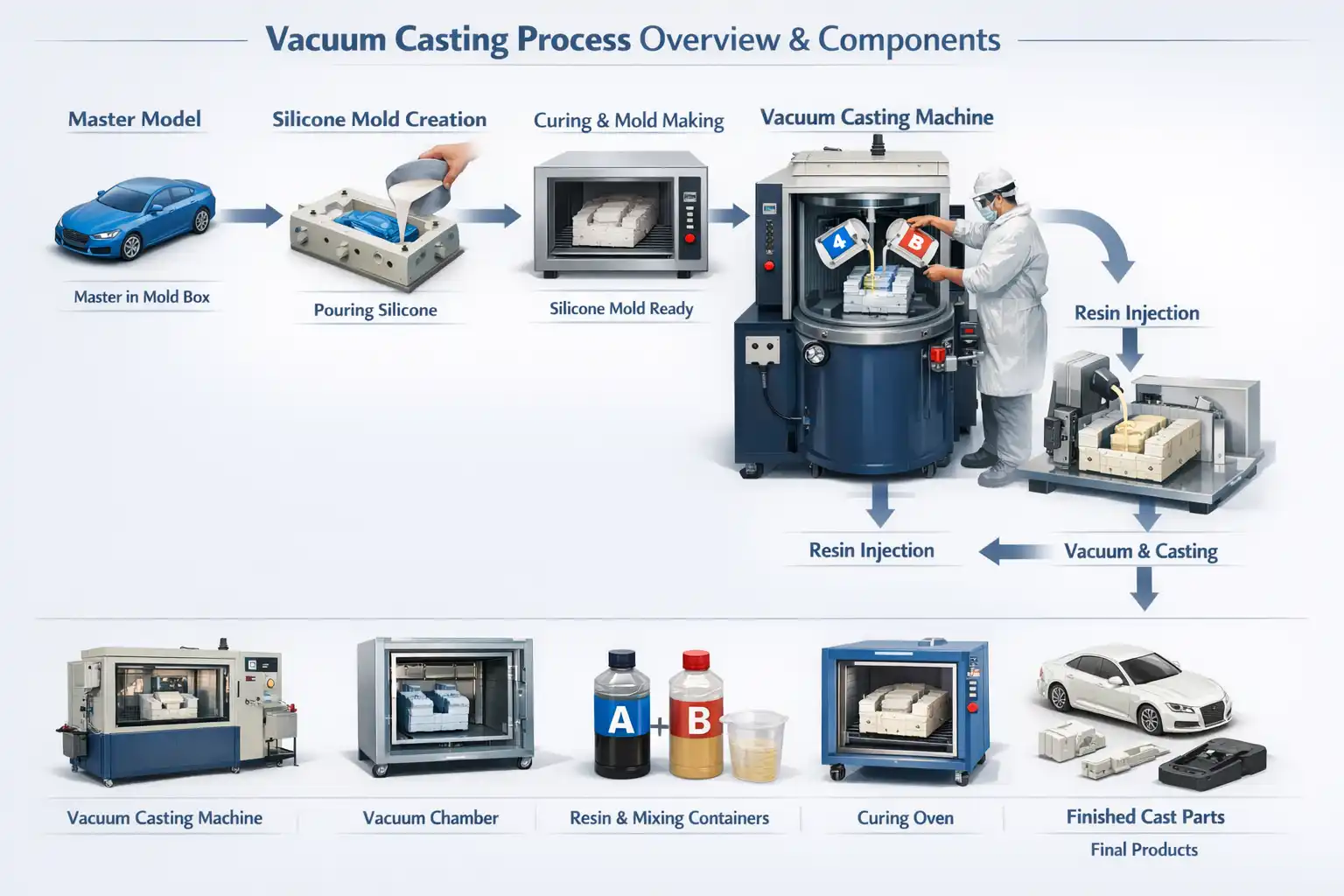
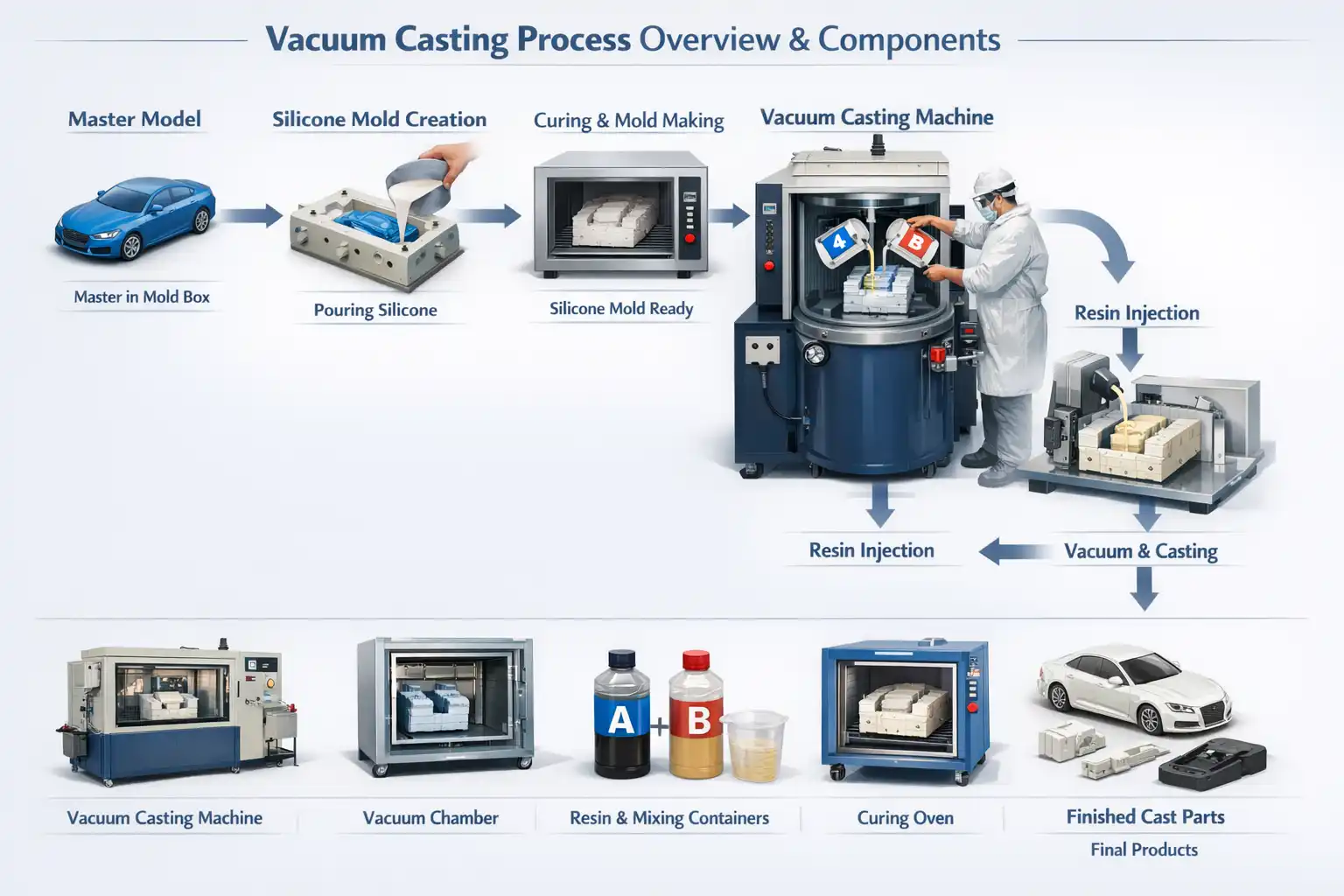
Rapid prototype casting — also called Vacuum Casting, silicone molding or polyurethane (PU) casting — sits between prototyping and mass production, and is one of the most widely used rapid prototyping methods for small batches. A master pattern is produced first, usually by CNC machining or 3D printing. That pattern is then used to build a silicone mold, and liquid resin is poured into the mold under vacuum to create parts that are near-identical copies of the master.
The real advantage is material realism. A cast part can be made from polyurethane resins that mimic ABS, PC, PP or rubber, in a wide range of colors and hardness levels. That makes rapid prototype casting the right process for parts that have to be tested in the real world — dropped, assembled, snapped together, put in front of a customer — not just looked at on a screen.
How Does the Rapid Prototype Casting Process Work?
The process has four stages, and each one directly affects the accuracy of the finished parts.
Creating the master pattern
Everything starts with a master pattern. It is normally machined from a plastic or metal block on a CNC machine, or printed on an SLA/SLS machine when the geometry is too complex to cut. Because every cast part is a copy of this single master, the surface finish and dimensional accuracy of the master set the ceiling for the whole batch.
Building the silicone mold
The master is suspended in a casting box and liquid silicone is poured around it. Once the silicone has cured, the mold is cut open along a parting line and the master is removed. A well-made silicone mold can usually produce around 20 parts before the parting line starts to wear — which is why rapid prototype casting works best for small batches rather than volume production.
Casting under vacuum
The mold is placed in a vacuum chamber and the resin is poured under vacuum. This is the step that separates vacuum casting from simple gravity casting: pulling the air out of the cavity prevents bubbles and voids, so the resin fills thin walls, sharp corners and fine surface detail cleanly. Parts come out with a surface finish that is close to Injection Molding quality.
Finishing and inspection
After demolding, parts are trimmed, sanded and finished. Color can be matched by mixing pigment into the resin before casting, or applied afterwards by spraying. Texture, gloss level and even laser-etched logos can be reproduced. The final step is dimensional inspection against the drawing, so you know the parts you receive match the CAD model.
How Does Rapid Prototype Casting Compare With 3D Printing, CNC Machining and Injection Molding?
Choosing between these four processes usually comes down to quantity, material requirements and how the parts will be used.
| Process | Typical quantity | Tooling cost | Material realism | Best for |
|---|---|---|---|---|
| Rapid prototype casting | 10 – 50 parts | Low (silicone mold) | High — PU resins mimic ABS, PC, PP, rubber | Functional testing, pre-launch samples, small market runs |
| 3D printing (SLA/SLS) | 1 – 20 parts | None | Medium — limited material range | Concept models, fit checks, complex geometry |
| CNC machining | 1 – 100 parts | None | Very high — real engineering plastics and metals | Tight tolerances, metal parts, functional prototypes |
| Injection molding | 1,000+ parts | High (steel mold) | Production material | Mass production |
In practice, most projects use more than one. A typical path is 3D printing for the first look, rapid prototype casting for the parts that need to be tested properly, then injection molding once the design is frozen. If you are not sure which stage you are at, send us your drawing and usage scenario and we will tell you which process fits — reply within 24 hours.
When Should You Choose Rapid Prototype Casting?
Rapid prototype casting is a strong fit when:
You need 10 to 50 parts, and the quantity is too high for 3D printing but far too low to justify a steel mold.
The parts have to be handled, assembled or tested, so material feel and mechanical behavior matter.
You need color matching or a specific surface texture for a trade show, investor demo or customer sample.
The design is still changing, so spending on hard tooling now would be premature.
You want a realistic bridge batch to sell or test in market before committing to mass production.
It is usually the wrong choice when you need thousands of parts, when the part must survive high temperature or heavy load in its final application, or when a tight metal tolerance is the priority — in those cases injection molding or CNC machining is the better route.
What Materials and Surface Finishes Are Available?
Cast parts are made from polyurethane resins rather than the pellets used in injection molding, so the material range is different. Typical options include rigid resins that behave like ABS or PC, softer elastomer-like resins for grips and seals, and transparent or water-clear grades for lenses and light guides. Hardness is usually specified on the Shore A to Shore D scale, so you can dial in anything from a soft rubber feel to a hard, impact-resistant shell.
On the finish side, parts can be supplied with a matte, satin or gloss surface, painted to a Pantone reference, textured to match a molded-in pattern, or treated with a soft-touch coating. See our materials and surface treatment options for the full list. If your product needs a specific finish to look production-ready, tell us the target and we will match it on the sample.
What Should You Prepare Before Requesting a Quote?
The more of the following you can provide, the faster and more accurate your quote will be:
A 3D file in STEP, STP, IGES or X_T format (a 2D drawing as PDF is also accepted).
The quantity you need, and whether you expect repeat orders later.
The material behavior you are after — rigid, flexible, transparent, or "like ABS".
Color and surface finish requirements, including any Pantone reference.
Critical dimensions and tolerances, if the part has to mate with something else.
How the part will be used, so we can flag any design issue before casting.
Send your drawing and usage scenario to our engineering team and we will come back with a process recommendation, lead time and quotation for our vacuum casting service — usually within 24 hours.
Frequently Asked Questions
How many parts can one silicone mold produce?
Around 20 parts is typical before the mold starts to wear. For larger batches we build additional molds from the same master, so quantity is not a hard limit.
How long does rapid prototype casting take?
Once the master pattern is ready, casting and finishing usually take a few working days depending on part size, quantity and finish requirements. The master itself is the longest single step.
Can cast parts be used as final production parts?
For small volumes, yes — cast parts are often sold as limited-edition or bridge-production units. For large volumes, injection molding is more economical per part.
Is rapid prototype casting the same as rapid prototype tooling?
No. Casting produces parts directly from a silicone mold. Rapid prototype tooling produces a short-run production mold, usually for injection molding. They are often used together — casting to validate the design, then rapid tooling to bridge to production.
Conclusion
Rapid prototype casting is the fastest way to get production-like parts into your hands without committing to hard tooling. It sits alongside our other rapid prototype services, including CNC machining and prototype model making, so we can advise on the right process for your stage of development rather than pushing a single one. Send us your 3D file and the quantity you need, and we will tell you within 24 hours whether casting is the right process for your project — and what it will cost. Contact us to start your project.